Category Archives: In the News

Trump’s FDA Nominee Spurs Concerns About Drug Approvals, Off-Label Promotion

Bronwyn Mixter, Bloomberg BNA: March 14, 2017

President Donald Trump’s pick to head the FDA is spurring concerns about drug approvals and off-label promotion.

Trump March 10 nominated Scott Gottlieb to be the commissioner of the Food and Drug Administration. The nomination was widely praised by drug and device industry groups, but a consumer group and other stakeholders told Bloomberg BNA they are concerned that Gottlieb, who is a resident fellow at the American Enterprise Institute and previously worked at the agency as a deputy commissioner, has advocated for quicker drug approvals with less evidence and wants to loosen restrictions on off-label promotion of drugs and medical devices. Critics of the nomination also are concerned that Gottlieb is too closely tied to industry. […]

Gottlieb “is someone who is entangled in an incredible, unprecedented web of ties to industry spanning his professional career,” Public Citizen’s Carome told Bloomberg BNA.

Carome said Gottlieb has been both a venture capitalist and sat on the boards of several drug companies. Gottlieb also “accepted large amounts of money for the period 2012 to 2015, at least $400,000, in speaking fees and consulting fees from several companies and we think it’s just impossible for him to really fully disengage from those ties to industry,” Carome said.

“Like many of President Trump’s other nominees, Scott Gottlieb has extensive financial ties to the industries he’d be in charge of regulating and has shown more interest in reducing regulations rather than enforcing them,” Diana Zuckerman, president of the National Center for Health Research, told Bloomberg BNA in an email.

Zuckerman said “when FDA focuses too heavily on easing the burdens on industry, that shifts the burden to patients, consumers, and physicians” and “none of us can make informed decisions about medical treatments, diagnostics, or prevention strategies when the FDA doesn’t require clear scientific evidence and isn’t transparent about its decisions.”

“If he becomes Commissioner, I hope Dr. Gottlieb will enforce the law and focus on fulfilling the FDA’s essential public health mission,” Zuckerman said. “I expect that industry will strongly support Dr. Gottlieb’s nomination but divesting could potentially be complicated and therefore could delay his confirmation.” […]

Read the full article here.

Statement of Dr. Diana Zuckerman, President, National Center for Health Research, Regarding the American Health Care Act

Diana Zuckerman, PhD, National Center for Health Research, on behalf of Cancer Prevention & Treatment Fund:  March 9, 2017

The goal of the American Health Care Act is to replace the Affordable Care Act (ACA) with something better, but instead it represents a giant step backward for health care for all Americans. This proposed plan will cover far fewer Americans than the Affordable Care Act (ACA), and insurance will pay for less and cost more. The proposed tax credits and Health Savings Accounts (HSAs) will not begin to provide adequate health insurance for Americans covered under the ACA, particularly low-income patients.

A substantial number of people who had health insurance for the first time under ACA will lose it. The proposed 30% surcharge for those who let their insurance lapse is an insufficient incentive for healthy people to purchase insurance. Since the surcharge is the same for patients whose insurance lapses for 2 months or 20 years, it actually discourages healthy patients from buying health insurance until they have substantial medical expenses. The lack of healthy patients in the insurance pool means higher premiums and deductibles for all of us. And, as more uninsured patients end up in hospitals needing expensive medical care for cancer, heart disease, or other serious illnesses, that uncompensated care means higher hospital costs for all of us.

The very obvious shortcomings of the proposed TrumpCare bill are the reasons why hospital organizations, the American Medical Association (AMA), AARP, and many insurers are all against this legislation. It would disrupt the marketplace, create confusion and uncertainty, and reduce or strip health care coverage from millions of Americans.

Meanwhile, the bill would provide tax breaks for the wealthy at the expense of those losing health coverage. The legislation also would serve to severely reduce Medicaid benefits over time, by eventually turning the Medicaid coverage now provided into block grants to states, many of which might spend the funds on issues other than health care.

Trump Picks Scott Gottlieb to Serve as FDA Commissioner

Anna Edney and Robert Langreth, Bloomberg Politics: March 10, 2017

  • Nominee was senior FDA executive under George W. Bush
  • Choice represents mainstream pick for pharmaceutical industry

Scott Gottlieb, a former deputy commissioner of the U.S. Food and Drug Administration, is President Donald Trump’s choice to lead the agency, according to an emailed statement from the White House.

Gottlieb, 44, served in several senior positions at the FDA during the George W. Bush administration. He has talked extensively about how to lower the cost of prescription drugs by modernizing the agency’s approval process and speeding cheaper generic competitors to market.

Since leaving the FDA, Gottlieb has worked as an adviser to investment firms and as a fellow at the conservative-leaning American Enterprise Institute, a Washington think tank. He has been the drug industry’s preferred choice for the FDA job and has worked as a consultant to some of its companies.

Gottlieb must be confirmed by the Senate before he takes over at the agency.

Mainstream Pick

Gottlieb is a more mainstream nominee than some of the other candidates who were said to be under consideration. He’s a partner at one of the world’s largest venture capital firms, New Enterprise Associates, which has a portfolio of more than 300 businesses in the technology and health-care industries, according to its website.

Other names for the FDA post that Trump considered in the past, according to people familiar, were Jim O’Neill, a Silicon Valley investor who has suggested that drugs need to be assessed only for safety, not efficacy, before they’re approved. Another was biotech executive Balaji Srinivasan, who’s tweeted that the FDA “bears responsibility for many deaths” because it “blocked many good drugs.”

While Gottlieb has focused on easing regulations, he “understands the agency and has some respect for it,” Diana Zuckerman, president of the National Center for Health Research, said in an interview before the news that Gottlieb is the leading candidate. The center is a Washington think tank that promotes education and research on policies that benefit patients. […]


Read the full article here.

Amid Flurry of New Cancer Drugs, How Many Offer Real Benefits?

Liz Szabo, Kaiser Health News: February 9, 2017

Marlene McCarthy’s breast cancer has grown relentlessly over the past seven years, spreading painfully through her bones and making it impossible to walk without a cane.

Although the 73-year-old knows there’s no cure for her disease, she wants researchers to do better. It’s been years, she said, since she has found a drug that has actually helped. McCarthy said she’s frustrated that the Food and Drug Administration is approving cancer drugs without proof that they cure patients or help them live longer. […]

Pushed by patient advocates who want earlier access to medications, the Food and Drug Administration has approved a flurry of oncology drugs in recent years, giving some people with cancer a renewed sense of hope and an array of expensive new options. A few of these drugs have been clear home runs, allowing patients with limited life expectancies to live for years.

Many more drugs, however, have offered patients only marginal benefits, with no evidence that they improve survival or quality of life, said Dr. Vinay Prasad, assistant professor of medicine at the Oregon Health and Sciences University, who has written extensively about the FDA’s approval process for cancer drugs.

Overall cancer survival has barely changed over the past decade. The 72 cancer therapies approved from 2002 to 2014 gave patients only 2.1 more months of life than older drugs, according to a study in JAMA Otolaryngology-Head & Neck Surgery.

And those are the successes.

Two-thirds of cancer drugs approved in the past two years have no evidence showing that they extend survival at all, Prasad said.

The result: For every cancer patient who wins the lottery, there are many others who get little to no benefit from the latest drugs. […]

In a November study published in JAMA Internal Medicine, researcher Diana Zuckerman looked at 18 approved cancer drugs that didn’t help patients live longer. Only one had clear data showing that it improved patients’ lives, such as by relieving pain or fatigue.

Two drugs harmed quality of life. For example, thyroid cancer patients taking the most expensive drug, cabozantinib, scored worse on a scale measuring five symptoms: diarrhea, fatigue, sleep disturbance, distress, and difficult remembering, Zuckerman said. […]

“We cannot have a system where drugs that may not even work are being sold for these amazingly crazy amounts of money,” said Zuckerman, president of the National Center for Health Research, a nonprofit in Washington that aims to explain research to consumers.

Recognizing the slow pace of progress, the American Society of Clinical Oncology has set goals for new cancer drugs of extending life or controlling tumors for at least 2.5 months. The bar was set relatively low because “it’s not very often that we come across a transformative treatment,” said Dr. Sham Mailankody, an assistant attending physician and myeloma specialist at Memorial Sloan Kettering.

Yet in a study published in September in JAMA Oncology, Mailankody found that only one in five cancer drugs approved from 2014 to 2016 met those standards. […]

The FDA wants to give patients the chance to benefit as soon as possible, rather than waiting for definitive proof of improved survival, Pazdur said. In some cases, the FDA requires pharmaceutical companies to perform long-term studies after drugs are approved, to measure whether drugs live up to their early promise.

But many of these studies never provide an answer, Zuckerman said. Once a drug is approved and is available to anyone, patients have no incentive to participate in a clinical trial. So studies can end with no clear conclusion. […]

Unless the FDA requires companies to provide survival data before approving a drug, “we may never have answers,” Zuckerman said. “We will have all of these expensive drugs on the market and we will never have the information we need about how well they work or even how safe they are.”

President Donald Trump has vowed to cut regulations at the FDA and recently told pharmaceutical industry leaders that he wants to further speed up the drug approval process. […]

Read the entire article here.

Trump Calls for Lower Drug Prices, Fewer Regulations in Meeting with Pharmaceutical Executives

Carolyn L. Johnson, The Washington Post: January 31, 2017

President Trump met with leaders of some of the world’s biggest pharmaceutical companies Tuesday and emphasized the need to lower “astronomical” drug prices, decrease regulations and bring more drug manufacturing into the United States.

Trump offered no specific policies, but mentioned increasing competition and “bidding wars” as a way to bring down prices. In the past, he has lashed out at the pharmaceutical industry for “getting away with murder” and threatened to use the government’s bargaining power to force down drug prices for programs like Medicare.

Most of Tuesday’s meeting was held behind closed doors, but Trump spoke to the media beforehand while surrounded by executives from a half-dozen large drug companies. He struck a less combative tone and didn’t mention government intervention directly.

“We have to get prices down for a lot of reasons. We have no choice,” Trump said, flanked by chief executives Kenneth Frazier of Merck and Robert Hugin of Celgene. “For Medicare, for Medicaid, we have to get the prices way down.”

In the past, pharma companies have railed against government intervention in pricing, saying those prices fund development of future, lifesaving drugs. […]

There are many empty positions at the FDA, said Diana Zuckerman, president of the National Center for Health Research. The recently enacted 21st Century Cures law provided for additional hiring authority.

“But with the hiring freeze, will they be able to hire anyone?” she asked. […]

Read the complete article here.

After Mastectomies, an Unexpected Blow: Numb New Breasts

Roni Caryn Rabin, The New York Times: January 29, 2017

After learning she had a high genetic risk for breast cancer, Dane’e McCree, like a growing number of women, decided to have her breasts removed. Her doctor assured her that reconstructive surgery would spare her nipples and leave her with natural-looking breasts.

It did. But while Ms. McCree’s rebuilt chest may resemble natural breasts, it is now completely numb. Her nipples lack any feeling. She cannot sense the slightest touch of her breasts, perceive warmth or cold, feel an itch if she has a rash or pain if she bangs into a door.

And no one warned her.

“I can’t even feel it when my kids hug me,” said Ms. McCree, 31, a store manager in Grand Junction, Colo., who is raising two daughters on her own.

Plastic surgeons performed more than 106,000 breast reconstructions in 2015, up 35 percent from 2000. And they have embraced cutting-edge techniques to improve the appearance of reconstructed breasts and give them a more natural “look and feel” — using a woman’s belly fat to create the new breast, sparing the nipple, minimizing scarring with creative incisions and offering enhancements like larger, firmer lifted breasts.

Read the rest of the article here.

2016 study explains why so many cancer drugs don’t work

Diana Zuckerman, PhD, Cancer Prevention & Treatment Fund

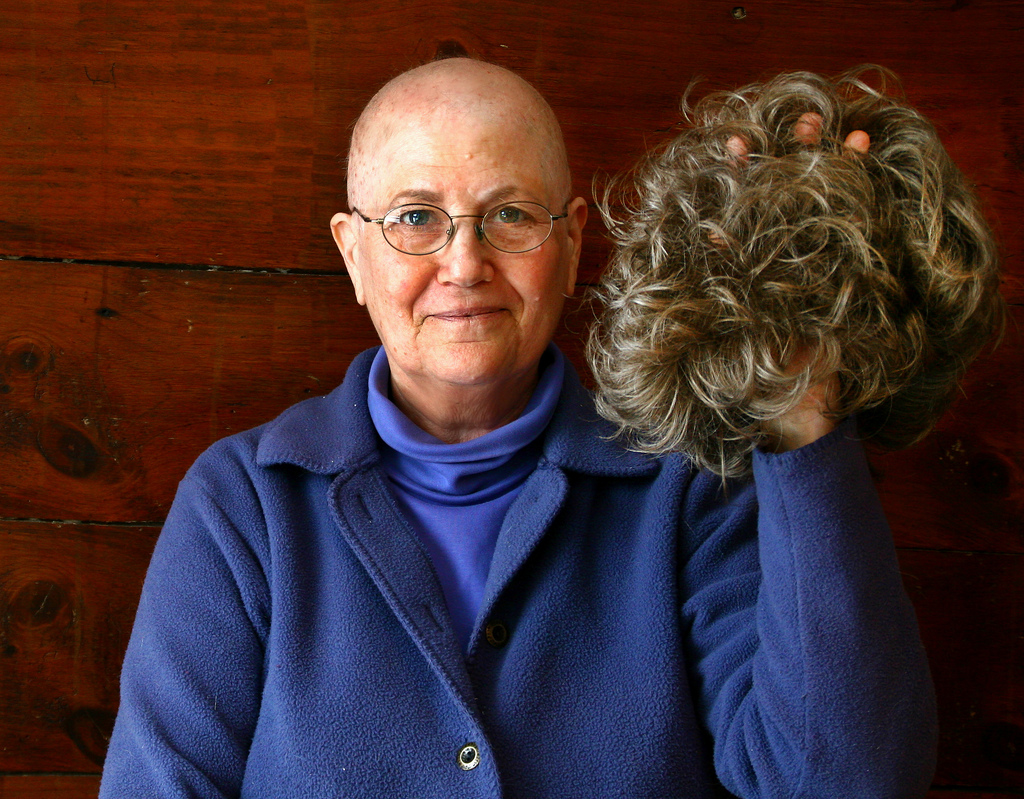
Most of us know cancer patients who received drugs that drained their energy and joy of living but didn’t seem to benefit them.  In some cases, the cancer stopped growing within a few months and even began to shrink, but ultimately the patient did not seem to live even a day longer.cancer patient

Why is that?

A key problem is that cancer drugs do not have to be proven to prolong anyone’s life in order for the Food and Drug Administration (FDA) to approve them.  Researchers at the National Cancer Institute and Oregon Health & Science University reviewed all the cancer drugs approved by the FDA from 2008 to 2012 (Kim & Prasad).  They found that 26 of the 54 cancer drugs were not required to be proven to prolong or save lives, but instead were approved based on what are called surrogate markers, which are “signs” such as tumor shrinkage that are expected (but not guaranteed) to predict patients’ longer life.

Once the drugs were approved, thousands of patients started taking these drugs and paying for them, despite the lack of evidence of a meaningful health benefit.  However, the FDA did require the companies to keep studying the drugs to find out if those medicines were actually extending lives.

The answer, unfortunately, is that many of these drugs did not help patients live longer or better.  Only five of the 36 drugs were proven to help patients live longer.  Eighteen drugs (50%) failed to extend life and 13 (36%) have unknown impact on survival because no data on them are available to the public.  Since companies are very good at sharing information when their drugs are proven effective, experts assume that means those 13 drugs are not proven to work.

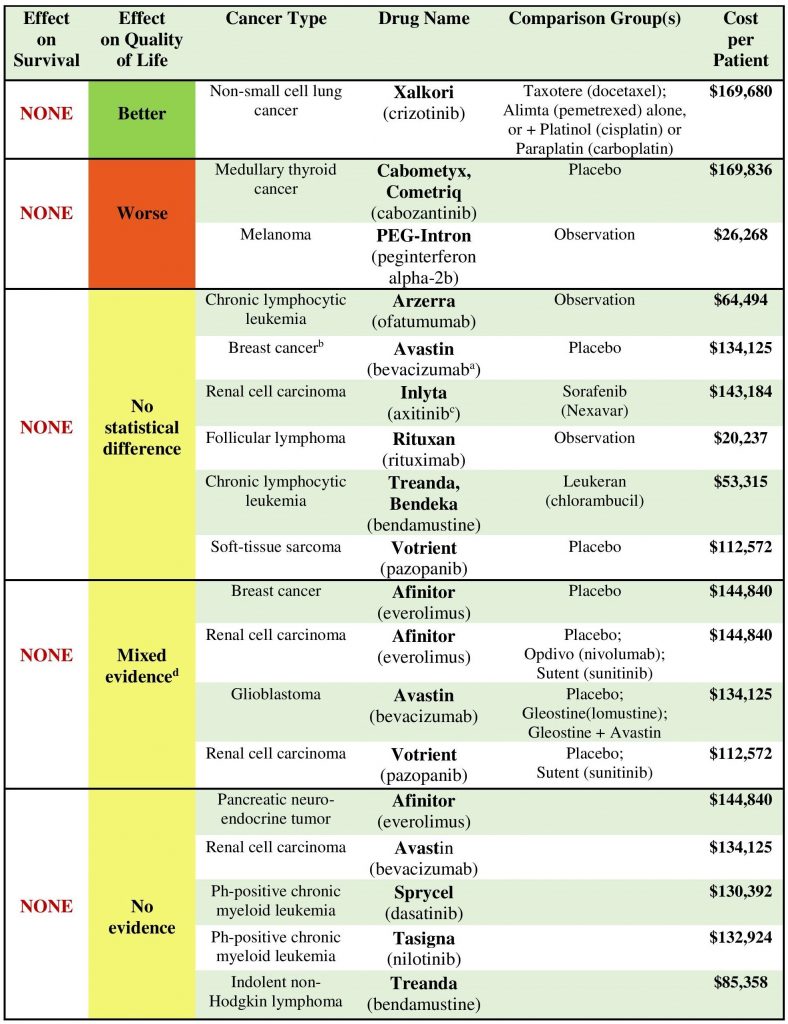
In November 2016, the National Center for Health Research published a study looking more carefully at those 18 ineffective drugs.  We found that only one was proven to improve quality of life – which isn’t surprising, since cancer drugs so often cause nausea, vomiting, hair loss, and exhaustion.  Two made quality of life worse, and the other 15 new cancer drugs either did not improve quality of life (6), or there is not enough evidence to know if they do or not.  We also looked at the cost of those cancer drugs and found something that doctors, patients, family members, and lawmakers need to know:  the new cancer drugs that are not proven to benefit patients in any way cost just as much as the ones that are effective – up to $170,000 per patient.  In fact, the most expensive of the 18 cancer drugs was a thyroid cancer drug (Cabozantinib, also called Cabometyx or Cometriq) that had no benefit to survival compared to placebo, and also caused patients to have a worse quality of life.

Meanwhile, the ineffective cancer drugs remain on the market and Medicare and insurers are still paying for them.  When the president of the National Center for Health Research asked FDA officials why they take so long to rescind the approval of ineffective cancer drugs, they stated that they still think those drugs might be effective, but that it is difficult to prove.  They pointed out that once a cancer drug is approved, it is very difficult to keep patients in a clinical trial long enough to know if the drug actually saves lives.  We agree it is difficult; if a patient is in a clinical trial and not doing well, he or she is likely to drop out, whether they are on the new drug, old drug, or placebo.  But that’s a major problem: if the FDA is approving cancer drugs on short-term, inconclusive data, and then requiring better studies that they know are unlikely to be completed appropriately, that’s quite a Catch-22.  It means that the FDA is approving cancer drugs knowing that we’ll never know if they are safe and effective or not.

This article is based on this study in JAMA Internal Medicine.1

Table 1. Most New Cancer Drugs That Don’t Help Patients Live Longer Also Don’t Improve Their Quality of Life

cancer-drug-table-page-001


a FDA review notes that sponsor stated one study found a difference in deterioration of QoL that was statistically significant in favor of bevacizumab.

b On November 18, 2011, FDA revoked accelerated approval of the breast cancer indication for bevacizumab.

c One subgroup analysis of Japanese patients found a QoL benefit.

d Includes any combination of the other categories (better, no statistical difference, worse).


P.S. In 2019, cancer therapy drug Lartruvo failed to meet the main goal in a late-stage trial testing the therapy in patients with advanced or metastatic soft tissue sarcoma.  Read more here.

Actress Elisabeth Rohm Urges You to Give Back and Join the Fight Against Cancer!

We are are proud to share our new public service announcement (PSA) featuring a devoted mother and talented actress, Elisabeth Rohm.

Click here to watch!


cyb6cm5xaaan6ei-jpg-large

You’ve seen Elisabeth in Law & Order, The Last Ship, and with Jennifer Lawrence in Joy and American Hustle. And she has just joined the cast of CW’s Jane the Virgin.  We hope you will join Elisabeth Rohm by supporting The Cancer Prevention and Treatment Fund with a donation today.

We need your support now more than ever because of the very real threats from Congress. They want to reverse the ban on cancer-causing chemicals in our air, water, and our homes and neighborhoods.  And they are trying to lower safety standards on cancer medications.

Your donation makes a difference, because 98 cents of every dollar goes directly to programs and services, making us one of America’s Best Charities. The Cancer Prevention and Treatment Fund thanks you for your support on Giving Tuesday, and will continue to work tirelessly in the fight against cancer.

Thank you in advance for considering us worthy of your support!

Congress Just Quietly Handed Drug Companies a Dangerous Victory

The 21st Century Cures Act has been lauded as a bipartisan success. It’s actually the result of a long war on drug regulation.

Christmas came early for the pharmaceutical industry this year. Last week, the Senate followed the House in passing the 21st Century Cures Act. Though this bill has been lauded by liberals for providing much-needed funds for medical research, its real impact will be elsewhere. Whereas drug approval traditionally required the demonstration of real clinical benefit in a randomized clinical trial, under the Act drug firms will increasingly be able to rely on flimsier forms of evidence for approval of their therapies (incremental steps in this direction, it is worth noting, have already occurred). The Act, by reconfiguring the drug regulatory process, lowers the standards for drug approval—a blessing for drug makers, but an ill omen for public health.

In the Senate, a grand total of five senators—including Bernie Sanders and Elizabeth Warren—voted against it. The media, meanwhile, has for the most part done a poor job dissecting its actual contents. As a result, few now realize how detrimental the act is likely to be for drug safety, or appreciate the mix of conservative ideology and pharmaceutical industry greed underlying the longstanding campaign that brought it to fruition.

The thinking behind the 21st Century Cures Act—and likeminded proposals—goes something like this: In the twenty-first century, the pharmaceutical industry—driven by the profit-motive—continues to do a fine job innovating new therapies. Far too often, however, they are being held back by risk-adverse, slow-moving FDA bureaucrats with outdated standards for approval. “Modernize” the FDA—release the cures! Yet if the law did nothing other than weaken FDA standards, it may not have passed: Liberals understandably embraced the act’s new NIH funding, its mental health provisions, and its support for state anti-opioid programs. For Democrats, it also represented the sort of bipartisan “victory” that shows that all is not gridlock in Washington, after all.                

Yet this thinking is flawed on multiple levels: “We need to remember,” as former editor-in-chief of the New England Journal of Medicine Marcia Angell wrote in her 2004 pharmaceutical exposé, The Truth About the Drug Companies, “that much of what we think we know about the pharmaceutical industry is mythology spun by the industry’s immense public relations apparatus.” First among these myths is the notion that the status quo of private sector drug research and development is the best of all worlds. On the contrary, as Angell put it, “me-too” drugs—lucrative, duplicative agents that do not improve on existing therapies—are in fact the “main business of the pharmaceutical industry.” We can’t rely on the profit motive to bring forth new cures, when it’s just as easy for companies to make big profits by redesigning or tweaking drugs that already exist.

Second, the notion of a slow-moving, risk-adverse FDA is wrong: If anything, the agency’s drugs review process is sometimes too hasty, while its standards of evidence for approval are frequently too lax. Consider, for instance, two recent studies of new cancer drugs. The first—published a year ago in JAMA Internal Medicine by Chul Kim and Vinay Prasad—looked at cancer drugs approved by the FDA on the basis of “surrogate endpoints” between 2008 and 2012. “Endpoints” is a term for outcomes: Hard clinical endpoints refer to outcomes such as survival, where the benefit to the patient is unambiguous. Surrogate endpoints, however, refer to metrics like the change in the size of a tumor on a CT scan. Though a shrinking tumor logically sounds like a good outcome, it is only meaningful if it actually translates into an improvement that an individual actually experiences, like a longer life or a better life. Often, however, that’s not the case: New therapies can change numbers without improving our actual health. This is what Kim and Prasad found: Of the 36 drugs approved on the basis of surrogate endpoints, at least half had no demonstrated benefit.

Perhaps they had other benefits? Or perhaps not. In late November, Tracy Rupp and Diana Zuckerman in the same journal examined these 18 drugs, and found that not only did they not improve survival, but only one had evidence that it improved quality of life (the others lacked data or had no effect, negative effects, or mixed effects). Despite this lack of benefit for either the quantity or quality of life, they note, the FDA withdrew approval for only one drug. Those drugs that either didn’t improve or actually worsened quality of life continue to be sold at an average price of $87,922 per year. Not a bad return for a basically useless drug.

How has this state of affairs come about? At least in part because, as scholar Aaron Kesselheim and colleagues describe in a 2015 study in the British Medical Journal, a total of five new “designations” and one new pathway (“accelerated approval”) have been created since 1983 to lubricate the drug approval process. As they find in their study, as of 2014 some two thirds of drugs are now being reviewed through one or more of these expedited programs, which sometimes allow them be approved more quickly, in some instances with skimpier evidence.

The 21st Century Cures Act will only take us further down this road. Indeed, as Trudy Lieberman has written at Health News Review, the bill is best seen as the “culmination of a 20-year drive by conservative think tanks and the drug industry that began during the Clinton Administration to ‘modernize’ the FDA.” PhRMA—the industry’s primary lobbying group—alone spent $24.7 million on Cures Act-related lobbying, according to data assembled by the Center for Responsive Politics and reported by Kaiser Health News. No less important, however, are the industry’s generous campaign contributions, which have helped construct a compliant and conducive political climate in Washington over the years.

The act reverses many of the protections that stemmed from the 1962 Kefauver–Harris Amendments, signed by John F. Kennedy, which bolstered the Food and Drug Administration’s (FDA) regulatory powers: These reforms meant the FDA could require proof not just that a drug was safe, but that it actually worked, prior to approval.


Read full article here.

Trump’s Rumored FDA Candidate Strikes Nerve

By Peter Sullivan, the Hill: December 8, 2016

The possibility that President-elect Donald Trump could nominate Jim O’Neill, a Silicon Valley investor with no medical background and controversial views, as head of the Food and Drug Administration (FDA) is setting off alarm bells among some healthcare experts.
[…]
The most attention has fallen on O’Neill’s comments in a 2014 speech, where he called for changing the FDA’s mission so that it no longer considers whether drugs are effective when deciding whether to approve them. Instead, O’Neill said the agency should only consider whether drugs are safe.
[…]
Diana Zuckerman, president of the National Center for Health Research, said that O’Neill’s idea of having the FDA no longer consider whether a drug is effective would cause chaos because insurance companies would no longer be able to use FDA approval to decide which drugs they would cover, and possibly could have to start making those determinations on their own.

“It would throw the entire U.S. healthcare system into turmoil,” she said.

To read the full story, click here