All posts by CPTFadmin

Some textured implants have a cancer risk. Here’s why women are told not to remove them

Joce Sterman and Alex Brauer, WJLA: September 16, 2019.


WASHINGTON (SBG) – We’ve all heard of recalls on cars and dangerous toys, but a global recall of a device that’s surgically implanted inside your body has thousands of women on alert. The recall of Allergan’s textured BIOCELL breast implants was prompted by a government analysis that showed an increased risk of cancer. Still, women who have them are generally being told not to have them removed from their chests.

For the last two months, Raylene Hollrah’s email and phone have been blowing up, with hundreds of women contacting her non-profit, dedicated to raising awareness about the emerging cancer. It’s called Breast implant-associated anaplastic large cell lymphoma, also known as BIA-ALCL.

The fear women are dealing with comes following the August global recall of Allergan’s BIOCELL textured implants due to the increased the risk of lymphoma, a cancer of the immune system that Raylene now knows all too well.

When she was diagnosed with BIA-ALCL in 2013, it was a brutal double whammy. Hollrah had survived breast cancer and a mastectomy. During reconstructive surgery in 2008, she got the textured implants that eventually gave her cancer a second time, making her just the 25th documented case of BIA-ALCL in the United States at that time. Her treatment and the research that preceded it came courtesy of Dr. Mark Clemens, who is a pioneer when it comes to researching the disease at MD Anderson Cancer Center in Texas.

In 2017, our Sinclair station in Washington, WJLA/ABC7 was one of the first in the country to tell Raylene’s story and highlight the link between textured breast implants and lymphoma. In that report, reporter Kimberly Suiters pointed out the Food and Drug Administration was aware of 258 confirmed cases of BIA-ALCL. But she said the warnings were not making it to women who might be at risk.

When she was diagnosed with BIA-ALCL in 2013, it was a brutal double whammy. Hollrah had survived breast cancer and a mastectomy. During reconstructive surgery in 2008, she got the textured implants that eventually gave her cancer a second time, making her just the 25th documented case of BIA-ALCL in the United States at that time. Her treatment and the research that preceded it came courtesy of Dr. Mark Clemens, who is a pioneer when it comes to researching the disease at MD Anderson Cancer Center in Texas.

In 2017, our Sinclair station in Washington, WJLA/ABC7 was one of the first in the country to tell Raylene’s story and highlight the link between textured breast implants and lymphoma. In that report, reporter Kimberly Suiters pointed out the Food and Drug Administration was aware of 258 confirmed cases of BIA-ALCL. But she said the warnings were not making it to women who might be at risk.

Allergan voluntarily pulled the implants as well as its related tissue expanders from the market, but they remain in thousands of women, many of them breast cancer survivors. And while a letter obtained by Spotlight on America shows the company is offering free replacement implants, it won’t pay for revision surgery.

The letter explains the decision not to cover surgical fees is in line with an FDA recommendation that textured implants not be removed in patients who have shown no symptoms of BIA-ALCL. The FDA is telling doctors to stop using the implants but has told women they can keep the implants if they’re not symptomatic.

Diana Zuckerman with the National Center for Health Research says, “Some of the women are going to say I don’t care what the FDA says, I’m getting them out.”

Zuckerman explained the FDA’s advice to keep the implants balances the risks of surgery with the chances of getting this type of lymphoma, which is rare. BIA-ALCL is also highly treatable and Zuckerman says removing the implants before a woman is diagnosed with BIA-ALCL is not a 100% guarantee that she won’t develop the disease.

And there’s another big question following the recall: exactly who has these implants? Zuckerman says many women don’t know and may struggle to find out as doctors don’t have to keep these records permanently.

That’s a big deal considering it could take years for this kind of cancer to develop. For Raylene Hollrah, her BIA-ALCL diagnosis came five years after she had her implants placed. After cancer a second time, she had them removed permanently. Now Hollrah has become an advocate for women in this same situation, making sure they know about BIA-ALCL.

So far no one has firmly pinpointed why these implants are a cancer risk, although many theories exist. And while the recall right now is only for Allergan’s BIOCELL textured implants, the FDA said it, “will continue to evaluate any new information and may, as a result, take action regarding other breast implants, if warranted.”

[…]

Read the full article here.

What Does Vaping Do To Your Lungs? Here’s What We Know

Yvonne Kim, Elite Daily: September 11, 2019.


In recent months, the national uptick in teen vaping has become less of a viral trend and more of a burgeoning public health emergency. Although e-cigarettes are nothing new, they are coming under increased scrutiny as otherwise healthy, young smokers experience a sudden rise in lung problems — and, now, even deaths. With investigations ongoing, it remains unclear exactly what vaping does to your lungs, but here’s what we know so far.

[…]

As of Sept. 6, the CDC has cited about 450 cases across 33 states of common symptoms — including chest pain, shortness of breath, and vomiting — among people with histories of vaping. While lung scan results appear similar to pneumonia, tests show there are no infections, according to The New York Times. There is yet no specific substance or product that links all the cases, but the CDC plans to continue identifying a cause through interviews and investigation. It launched an official investigation on Aug. 1, 2019, according to the press release.

“We are committed to finding out what is making people sick,” CDC Director Robert Redfield said in another press release. “All available information is being carefully analyzed, and these initial findings are helping us narrow the focus of our investigation and get us closer to the answers needed to save lives.”

How Safe Are Breast Implants, Really?

Rebecca Nelson, Elemental by Medium: September 3, 2019.


When Jamee Cook got breast implants at 21, she hoped to feel more confident about her body. Instead, the implants nearly ruined her life.

Just three years after her surgery, Cook, who is now 42, started having a slew of medical problems: fatigue, fevers, sinus infections, memory problems, and trouble concentrating. She felt like she constantly had the flu and could barely muster the energy to take care of her three kids. Because of her health problems, she had to quit her job as a paramedic. Four years ago, she finally saved up enough money to get her implants removed due to the complications and discovered her symptoms subsided. “I felt like I did a turnaround,” she says. She had finally gotten her life back.

Cook is not an outlier among women with breast implants. The safety of breast implants has long been a topic of debate in the medical community. After a safety scare in the 1990s, silicone implants were banned for more than a decade before the U.S. Food and Drug Administration (FDA) allowed them back on the market in 2006. But a growing body of evidence suggests that these newer breast implants aren’t as safe as this generation of women has been led to believe. The FDA requested in July that the implant manufacturer Allergan recall their textured implants, citing a link to a rare cancer called breast implant-associated anaplastic large cell lymphoma. And an online movement of thousands of women who say their implants have made them sick is calling more attention to other long-term complications.

Breast implants first came on the market in the U.S. in the 1960s. They are classified as medical devices by the FDA and an estimated 10 million women around the world have them currently. While the vast majority of those women don’t have issues, there’s increasing evidence that implants are associated with serious risks. But the available data on their safety is of poor quality, and doctors, researchers, and patients disagree about what some of the risks actually are — making it all the more difficult for women to determine them before making a decision.

The medical community has long downplayed the potential complications of implants, says Diana Zuckerman, the president of the National Center for Health Research in Washington, D.C., who has studied implants. “There are many, many plastic surgeons whose entire livelihood depends on doing breast augmentation surgery. If they were to tell every patient what all the risks are, they’d have fewer patients.”

Here’s what’s known for sure: Nearly 600 cases of breast implant-related anaplastic large cell lymphoma, a cancer of the immune system, have been reported to the FDA. As of July, 33 people died from it. Textured implants made by Allergan were linked to the cancer, and recalled globally that month. While the FDA says there’s generally a low risk of people with breast implants developing cancer from them, the agency said in a statement at the time that “we believe all individuals who are considering a breast implant of any type be informed of the risk.”

“Of the millions of women with breast implants, we know that complications occur in at least 1% of patients,” says FDA spokeswoman Stephanie Caccomo. “We believe, though, that all women should be aware of the potential risks and complications of breast implants, which are not lifetime devices.”

People who consider implants may be unaware that they are viewed as temporary devices to be removed or replaced at a later date. According to the FDA, the longer people have the implants, the higher their risk for complications. “The life of breast implants varies by person and can’t be predicted,” reads a FAQ about breast implants on the agency’s website. “That means everyone with breast implants will face additional surgeries — but no one can tell them when. And while a few people may keep their original implants for 20 to 30 years, that is not the common experience.”

[…]

Read the full story here.

Teens Are Being Hospitalized After Vaping: Here’s What We Know So Far

Parents, Yahoo! Lifestyle: August 27, 2019.


Last month, a 17-year-old from Texas named Tryston Zohfeld‘s lungs suddenly failed. He was rushed to Cook Children’s Hospital in Fort Worth, Texas and put into a medically-induced coma while the situation only worsened. X-rays found that the teen had a total blockage of his lungs. Ruling out diseases like pneumonia, doctors finally concluded that the lung inflammation and inability to exchange oxygen and carbon dioxide Zohfeld was experiencing had been brought on by chemicals the teen had been inhaling from his vape pen, which he had been regularly using since 8th grade.

While Zohfeld was grateful to be released from the hospital after an 18-day stay, his story is just one of several cautionary tales related to vaping and e-cigarettes that are making headlines nationwide. A 20-year-old from Utah named Alexander Mitchell was recently “on death’s door” after his lungs failed. The young man had been using e-cigarettes. Also this summer, 18-year-old Chance Ammirata’s lung collapsed. The Miami student admitted to vaping about one Juul pod every two days (roughly the equivalent of 10 cigarettes-worth of nicotine a day) for a year.

Now, the U.S. Centers for Disease Control and Prevention (CDC) is conducting an ongoing investigation into cases like these. Here’s what you need to know.

[…]

The Dangers of Vaping for Teens

With hope, the ongoing CDC and FDA investigations will offer parents more answers about the link between e-cigarette use and lung disease, but in the meantime, experts are noting that teens are an especially vulnerable group.

Diana Zuckerman, PhD, president of the National Center for Health Research told CBS News, “It seems some kids are having very measurable damage in a very short period of time than what we’ve seen from [cigarette] smoke.” She explained that a young person’s size might be a factor in how they experience the effects of the chemicals, noting, “The same amount of vaping for a child that weighs, say, 100 pounds, is a bigger issue than for somebody who weighs 200 pounds.”

At the same time, e-cigarettes that include nicotine put teens at risk of addiction, which amplifies their risk of illness. Teens who use nicotine can become addicted in just days. Yale Medicine pediatrician Deepa Camenga, M.D., says that nicotine affects teens differently than adults because “teens are just more vulnerable than adults are to developing an addiction to nicotine. As a result, it may be harder for teens to stop because their brain is still growing and developing.”

Potential Lung Damage Symptoms from Vaping

The CDC notes that “in many cases, patients reported a gradual start of symptoms” including:

  • breathing difficulty
  • shortness of breath
  • and/or chest pain before hospitalization
  • in some cases, mild to moderate gastrointestinal illness including vomiting and diarrhea and fatigue

People who experience illnesses after vaping are encouraged to report the incident to the FDA here.


Read the original article here.

Sample Vaping Letter

If you’re concerned about the epidemic of e-cigarettes and vaping, contact your two U.S. Senators to let them know how you feel!  A sample letter is below.  Here is a link to find the names and contact info for your senators.


Dear Senator_____:

I am very concerned about the dangers of e-cigarettes and I am writing to ask you to require that Congress address this serious epidemic.  Action is urgently needed since the Centers for Disease Control and Prevention (CDC) is investigating reports that more than 250 people, including many teenagers and young adults, have suffered harm and in some cases, hospitalization because of lung injuries from vaping.

One man in Illinois has died and vaping is strongly suspected as the cause of his fatal illness.

Scientists are studying whether certain brands of e-cigarettes are most likely to be harmful, and whether the lung damage is caused by the chemicals, contamination or other causes.  Meanwhile a range of vaping products are widely sold and teens and adults are being seriously harmed.

In 2016, the Food and Drug Administration’s (FDA’s) Center for Tobacco Products (CTP) issued regulations aimed at restricting access to e-cigarettes and requiring studies of their risk.  The regulations were supposed to go into effect in 2018, but were delayed.  Meanwhile, the FDA has failed to require the companies to prove that their products are safe.

The industry and the scientists they have hired claim that vaping helps people to quit smoking, but that has not been proven.  Meanwhile, we now know that vaping can cause serious lung damage in just a year or two.  That’s faster than cigarettes, which generally take decades to cause serious harm.

After initially delaying the regulation of e-cigarettes for 4 years, the former FDA Commissioner, Dr. Scott Gottlieb, modified his views, calling vaping an epidemic, and vowed that the agency would take appropriate action.

Please become a co-sponsor of the SAFE Kids Act (S. 655), which would ban most flavoring from e-cigarettes.  These flavors are a major reason why children like to vape.  In addition, please contact the FDA and urge the agency to immediately restrict the marketing of e-cigarettes and require that these devices be drastically restricted until the companies submit conclusive safety data through the PMTA process.  The current delay is harming unknown numbers of teens and adults.

  Sincerely,

E-cigarettes affect a person’s blood vessels after just one use, study finds

Caitlin O’Kane, CBS News: August 22, 2019.


Vaping, even temporarily, can affect the blood vessels in healthy people — even if the vape pod does not contain nicotine, according to a new study published in the journal Radiology this week.

Researchers from the University of Pennsylvania School of Medicine studied 31 volunteers, all of whom were healthy, non-smoking adults with an average age of about 24 years old.

The participants were monitored as they each took 16 three-second inhalations from a disposable e-cigarette. The researchers used an ePuffer with flavored e-cigarette liquid but no nicotine in it. A research coordinator made sure sure the participants did not cough or swallow the vapor.

The researchers then conducted MRI scans on the participants and found a reduction in blood flow in the femoral artery in their legs. This change occurred after just one vaping experience.The findings suggest vaping impaired function of the endothelium, or inner lining of blood vessels, a press release on the study explained.

“These products are advertised as not harmful, and many e-cigarette users are convinced that they are just inhaling water vapor,” Alessandra Caporale, Ph.D., a post-doctoral researcher and lead author of the study, said in a statement. “But the solvents, flavorings and additives in the liquid base, after vaporization, expose users to multiple insults to the respiratory tract and blood vessels.”

[…]

“Lung damage is what we’re most focused on right now, but there’s so much more going on,” Dr. Diana Zuckerman, president of the National Center for Health Research, recently told CBS News. “There are chemicals in Juul and e-cigs and we’re not exactly sure what the impact is going to be because we haven’t seen it before.”

A study published in the journal Pediatrics last year found a number of different toxic chemicals in e-cigarettes, including one linked to several types of cancer. Some of the chemicals turned up even when teens used non-nicotine products like fruit-flavored vapes.

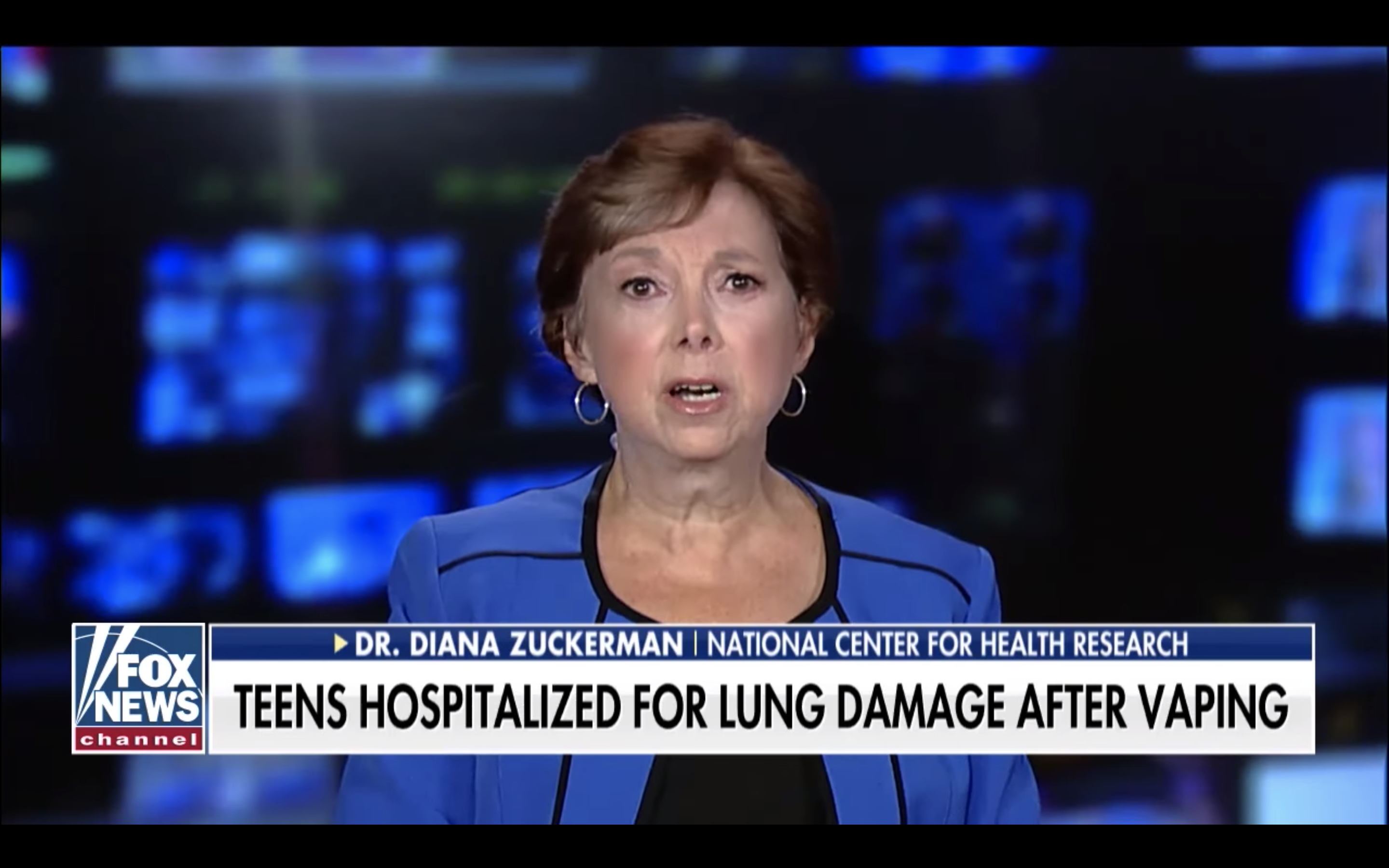
Teens Are Being Hospitalized With Lung Damage From Vaping At An Alarming Rate

Emily Reily, Yahoo! Entertainment: August 14, 2019.


A surprising number of teens are suffering from lung damage, and it appears to stem from vaping.

Young Adults Getting Lung Damage

Several cases of severe lung damage were reported in Wisconsin last month, and it’s got medical professionals talking.

“It’s mind-boggling. I’ve never heard of a smoker ending up in the hospital in their teens,” says Dr. Diana Zuckerman, president of the National Center for Health Research.

We Have Evidence Now

And we have real, concrete examples of lung damage in young people.

A teen who said he vaped one Juul pod every two days for a year eventually suffered a collapsed lung.

“He didn’t have the symptoms that might have warned him that something was wrong — until something was really terribly wrong,” added Zuckerman.

[…]

Studies Confirm E-Cigs Are a Bad Idea

The journal “Pediatrics” published a study last year on e-cigarettes, noting that there is a slew of toxic chemicals in them. Some of those chemicals are linked to cancer.

“It seems some kids are having very measurable damage in a very short period of time than what we’ve seen from [cigarette] smoke,” adds Zuckerman.

Read the original story here.

Teens are being hospitalized for lung damage after vaping — “It’s mind-boggling,” doctor says

Caitlin O’Kane, CBS News: August 13, 2019.


In Wisconsin, at least a dozen people have recently been hospitalized and treated for severe lung damage. The first cases were reported last month, and the number has been growing. All of these patients are young — between their teenage years and 30s — and all of them appear to have been harmed by vaping.

Wisconsin’s Department of Health Services confirmed 12 cases and is investigating 13 others, including older patients up to their 50s who are experiencing lug damage as a result of vaping, according to The Milwaukee Journal Sentinel.

The hospitalization of at least a dozen young people raises the question: How have e-cigarettes caused so much damage, when they haven’t even been around for that long?

“It’s mind-boggling,” Dr. Diana Zuckerman, president of the National Center for Health Research, told CBS News. “The vast majority of people who smoke started as children or as young teens, and yet you don’t hear about people getting lung cancer until their 40s, 50s, 60s,” she said. “Think about that compared to what’s happening to these kids now. I’ve never heard of a smoker ending up in the hospital in their teens.”

Zuckerman pointed to one specific case: a college freshman from Florida whose lung collapsed. In an interview with The Daily Mail, the teen admitted to vaping about one JUUL pod every two days for a year. 

“Really, a collapsed lung on an 18-year-old after one year? That’s mind-boggling,” Zuckerman said.  “He didn’t have the symptoms that might have warned him that something was wrong — until something was really terribly wrong.”

The big problem she sees with Juul and other e-cigarettes and vapes: “We don’t know yet what the symptoms might be,” Zuckerman said.

It took doctors years to fully understand all of the risks associated with smoking cigarettes, including cancer, Zuckerman said. When it comes to vaping, it is too early on for doctors to know all the potential long-term health consequences. However, there is growing evidence of short-term risks and lung damage, according to Zuckerman.

“Lung damage is what we’re most focused on right now, but there’s so much more going on,” she said. “There are chemicals in Juul and e-cigs and we’re not exactly sure what the impact is going to be because we haven’t seen it before.”

[…]

While there are many unanswered questions about vaping that may be revealed over time, one thing is starting to become clear to Zuckerman: “It seems some kids are having very measurable damage in a very short period of time than what we’ve seen from [cigarette] smoke.”

Juul’s popularity with teens is a particular concern because the rash of lung problems appears to be affecting young people more than any other age group. “The same amount of vaping for a child that weighs, say, 100 pounds, is a bigger issue than for somebody who weighs 200 pounds,” Zuckerman said.

See the original story here.

What’s behind the surge of prescriptions for risky, expensive medications? Millions from drugmakers.

John Fauber, Milwaukee Journal Sentinel: August 8, 2019.


In 2011, a group of influential dermatologists, most of whom had financial ties to drug companies, issued a set of national guidelines for treating psoriasis.

It said a class of immune-suppressing drugs could be used to clear up mild skin issues before weddings or other special events.

The problem: The recommendation went against the approved uses for the drugs, which carry stringent safety warnings from the U.S. Food and Drug Administration.

In 2012, AbbVie created a “Nurse Ambassador” program that paid nurses around the country to make home visits to patients who had been prescribed Humira, its rheumatoid arthritis and psoriasis drug.

The wrinkle: The nurses were instructed not to mention the risks of the drug, which include potentially deadly infections, according to a lawsuit filed by California regulators.

In 2014, Pfizer paid for a study of its rheumatoid arthritis drug Xeljanz — one authored by 12 experts, all with financial ties to the company. Xeljanz came out on top.

The twist: It was not compared to the treatment experts consider the most effective.

All three efforts were part of a massive drug company push to boost the sale of expensive, immune-suppressing drugs to treat autoimmune conditions such as psoriasis and rheumatoid arthritis.

The drugs, many of which are biological medicines, called biologics, were introduced two decades ago and have hit $45 billion in sales, despite escalating prices and mounting reports of serious side effects.

“There are a lot of different playbooks on drugs,” said Diana Zuckerman, president of the Washington, D.C.-based National Center for Health Research, a public health advocacy group. “The industry knows how to sell a product.”

AbbVie’s nurse program is the focus of an insurance fraud lawsuit filed last year by the California Department of Insurance. It alleges the company paid kickbacks to doctors to prescribe the drug and sent the nurses into homes “to keep patients on a dangerous drug at any cost.”

The lawsuit, which claims more than $1.2 billion in insurance fraud, alleges the nurses were trained to hide Humira’s serious cancer and infection risks — allegations AbbVie denies.

The nurse program offers a unique spin on what past Milwaukee Journal Sentinel investigations have found to be a pattern of drug company money touching every step of the process.

Upbeat TV commercials and magazine ads that tout the benefits of the drugs.

Treatment guidelines that call for doctors to prescribe them — written by doctors with financial ties to drug companies.

Favorable studies underwritten by drug companies — often conducted by researchers who double as speakers and consultants to the companies.

Biologic drugs are cultured from animal cells and introduced by injection or IV.

The drugs are often effective and can lead to significant improvement in symptoms, even remission. But they also leave patients susceptible to a growing number of infections and other serious side effects.

Of the 21 biologic drugs that have won FDA approval, 13 — 62% — have received the agency’s most stringent warning, known as a “black box.” In the majority of those, the warnings were added when serious risks and side effects began showing up after the drugs were on the market.

Earlier this year, a Milwaukee Journal Sentinel investigation found more than 1 million “adverse events” were reported to the FDA in people using the drugs since 2004, including nearly 500,000 that were deemed serious.

There were 34,000 reported deaths.

While the FDA database has limitations, including a lack of verification of the reports and the possibility that other drugs could also have been used, it is the largest publicly available data set of reactions associated with prescription drugs.

If anything, experts say, it undercounts the potentially dangerous incidents.

Zuckerman, the head of the public health advocacy group, said part of the drug company strategy is to get the FDA to approve more and more products — or to get existing drugs approved to treat more and more conditions. 

That creates a confused marketplace.

“The doctors are left with 20 different products and no idea which one is best for which patient,” she said.

Rising competition, rising costs

Led by top-selling Humira, biologic drugs have become some of the biggest moneymakers for the U.S. pharmaceutical industry.

Prescriptions for them were on pace to exceed more than 6 million in 2018, up from about 4 million in 2013, according to data from the pharmaceutical market research firm IQVIA. That represents a 50% increase.

Humira prescriptions were set to top 3 million, an increase of more than 60%.

Meanwhile, biologic drugs were expected to tally $45 billion in sales, with Humira on pace to hit $18 billion alone — an increase of more than 150% since 2013.

The list price on the drugs can exceed $40,000 a year, though rebates and discounts can reduce the amount paid by insurance companies and individuals.

There are now more than 20 biologic drugs on the market, in addition to other, traditional treatments for the conditions.

Yet prices seem to defy the laws of supply and demand.

February 2019 paper in the journal JAMA Internal Medicine looked at three of the most popular biologic drugs in a class known as tumor necrosis factor inhibitors: Humira, Enbrel and Remicade.

Before 2009, they were the only such drugs approved to treat rheumatoid arthritis.

In the years that followed, the FDA approved three more drugs — increasing competition. The study authors expected costs would still rise 34% from 2009 to 2016, due to inflation and other factors. Instead, costs went up 144%.

[…]

California alleges insurance fraud

In September 2018, the California insurance commissioner’s office laid out its case of financial impropriety against AbbVie, providing a window into the push to boost sales of Humira.

A similar lawsuit was filed in federal court in Illinois.

That lawsuit alleges AbbVie officials “bragged at national sales meetings about how the Ambassador Program resurrected the otherwise plateauing sales of Humira and attributed a sharp and specific rise in sales directly to the Ambassador Program.”

Both cases are pending. AbbVie denies wrongdoing.

[…]

The California lawsuit alleges the program began as a pilot effort in 2012, developed a presence in California in 2013 and soon became “wildly successful in this state and others.”

Through the program, doctors allegedly got kickbacks in the form of cash, meals, drinks, gifts, trips, even patient referrals.

One court document indicates the national program reached 179,000 patients.

“Kickbacks and more sophisticated schemes, like those alleged in the AbbVie case, are significant drivers in the out-of-control cost of prescription drugs that harm consumers,” California Insurance Commissioner Ricardo Lara said in a statement to the Journal Sentinel.

His office estimates private insurers in California alone paid out $1.2 billion in Humira claims from 2013 to 2018, making it potentially the largest insurance fraud case in the department’s history.

[…]

Major marketing push

In 2018, Humira topped all drugs for ad spending, at $483 million, according to data from the firm Kantar Media, which tracks cross-media ad spending.

Xeljanz, a non-biologic that competes in the same market, was third at $256 million. Cosentyx, a biologic, was eighth at $180 million.

The totals include all ad spending, aside from social media, but TV commercials are clearly at the center of marketing efforts — particularly on cable news networks.

During a five-day span in mid-March, a total of 21 commercials for autoimmune system drugs — most of them biologics — were aired during cable news shows on CNN, Fox and MSNBC between 6 and 9 p.m., according to a Journal Sentinel analysis.

[…]

Rita Redberg, editor of the journal JAMA Internal Medicine, said she is struck by how many of the drugs are advertised on TV.

“It is clear (the drugs) are not selling on the merits alone, otherwise they wouldn’t need all the advertising,” said Redberg, a professor of medicine at the University of California, San Francisco.

Drug companies and treatment guidelines

Doctors frequently turn to treatment guidelines when it comes to determining how to care for patients. The guidelines, which serve as national standards for treating various diseases, often are used by front-line doctors who see patients and write prescriptions.

They are frequently issued by medical societies and related groups.

Where do the groups get their money?

Often from companies marketing the drugs.

[…]

Consider the 2011 guidelines for treating psoriasis and psoriatic arthritis issued by the American Academy of Dermatology.

Those guidelines said that if a person with a milder case of the disease has an important upcoming event, such as a wedding or graduation, it is OK to use biologic and other drugs.

However, the FDA has only approved biologic drugs for more serious cases, what is known as moderate to severe psoriasis.

The guideline-writing committee was made up of 15 experts, 12 of whom — including the chairman — had financial ties to companies that make biologic drugs.

At the time the guidelines were issued, committee chairman Alan Menter disclosed he received money from three companies that make biologic drugs for psoriasis, but did not list the amounts.

A check of the federal government’s Open Payments database showed that in 2013 he received about $90,000 from those companies. He continued to work with the companies, receiving more than $300,000 between 2014 and 2017.

[…]

Meanwhile, the American Academy of Dermatology has received millions of dollars in funding in recent years from companies that manufacture biologic drugs, based on giving levels the group lists on its website and other records. AbbVie, the maker of Humira, alone gave more than $2 million in grants and donations to the academy between 2013 and 2017.

[…]

Less expensive option not recommended

Financial conflicts were also at play in 2015 treatment guidelines for rheumatoid arthritis from the American College of Rheumatology.

Rheumatoid arthritis causes inflammation, leading to swelling, pain, stiffness and potential damage to the joints. The condition affects more than 1 million Americans.

Experts generally agree that the best first-line treatment for the condition is the generic drug methotrexate, which is normally is taken by mouth. If that fails, a biologic can be added.

But there are other options, such as adding two generic and less expensive non-biologic drugs — what is known as “triple therapy.” A 2013 paper in the New England Journal of Medicine showed that approach to be just as effective as adding the biologic Enbrel.

The effectiveness may be equal, but there is a dramatic difference in cost.

“Triple therapy” costs less than $4,000 a year, while taking a biologic drug costs about $43,000, according to an analysis provided to the Journal Sentinel by Alvaro San-Juan-Rodriguez, a research fellow at the University of Pittsburgh School of Pharmacy.

When the American College of Rheumatology issued its treatment guidelines in 2015, it did not factor in the difference in cost, which would have put biologics at a disadvantage.

The guidelines simply said either approach could be used.

Nine of the 26 members of the committee had financial relationships with companies that either made or were developing biologic drugs at the time, a Journal Sentinel analysis found.

[…]

Study ignores most effective treatment

The influence of drug company money is increasing among experts who author papers about drugs used to treat rheumatoid arthritis, according to a May 2019 paper in the journal Rheumatology.

The paper found conflicts of interest among authors in 54% of studies in 2002 and 2003. That increased to 65% for the second period examined, 2010 and 2011.

A Journal Sentinel examination of rheumatoid arthritis studies and financial disclosure forms found an especially conflicted 2014 study of the Pfizer drug Xeljanz.

All 12 authors had financial ties to the company, including eight who were employed by Pfizer, which funded the study.

What’s more, the study compared Xeljanz to the drug methotrexate alone — not the more effective treatment of methotrexate plus a low-dose steroid. The study concluded Xeljanz was better.

Other studies of rheumatoid arthritis drugs have taken the same approach.

Pfizer spokesman Steven Danehy noted the study authors are recognized experts in the field and work with many pharmaceutical companies. He added: “Further, the New England Journal of Medicine works with an editorial team that employs rigorous editorial, peer and statistical processes to evaluate manuscripts for scientific accuracy.”

Critics question why Xeljanz was tested against a “second-best treatment” — and whether patients in the trial knew what they were getting.

“Comparing the new treatment to a treatment that we already know is not good enough proves nothing,” said John Kirwan, an emeritus professor of rheumatic diseases at the University of Bristol in the U.K.

“You can’t help thinking that the company designed their study this way just to make their new treatment look good.”


Read the original article here.